A Founders Thoughts
A founder’s thoughts on a historic dairy farm, live-fire cooking, and a different kind of evening.
There are plenty of things to do in Coeur d’Alene. That is the easy statement. You can get on the lake, hike, bike, walk downtown, sit outside somewhere with a drink, find a good meal, and watch the evening light do what it does around here. This area gives people a lot without much trouble.
Still, I keep coming back to that phrase: things to do in Coeur d’Alene. It is useful. People search for it. Visitors ask about it. Locals ask about it when friends or family come to town and they want to show them something that actually feels like this place.
The phrase can feel a little small, maybe even generic though. Some things give you a nice evening. Some things fill a spot on the calendar. Then there are the rarer things that change the feel of it. There are things, like what we have built here that help you feel the place you are in, giving people a memory with more weight than, ‘we went there and ate.’
That is the category I keep hoping Discovery Fire can keep growing into. I do not think we get to declare it. Guests decide that. But the hope has always been to create something people step into and really experience on a more visceral level. Something that makes ‘things to do in Coeur d’Alene’ feel like an understatement.
The Farm Came First
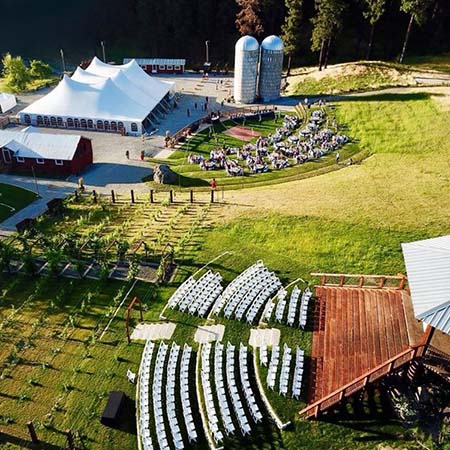
Before Discovery Fire had a name, there was the farm. A local (3 miles from town) beautiful Historic dairy farm with that legacy baked into the ground and all the hard work within the bones of it. We have spent close to twenty five years bringing this place along, converting it, repairing it, reshaping it, and trying not to lose what made it feel real in the first place.
Old farm properties are funny that way. You do not simply turn them into whatever you want. At least I do not think you do. Instead, you listen for a while. You make some mistakes. You notice where the light falls, where the wind moves, where people naturally gather, and where the old structures still have something to say.
For a long time, this property worked in the old way. It was a dairy farm: animals, chores, equipment, mud, weather, routines. Then it became Settlers Creek, and it started working in another way, holding all sorts of private events, weddings, gatherings, celebrations, and important days in people’s lives.
That has meant a lot to us. Over time, though, I wanted a more interactive way to share what we had grown to love here: the acres of open space, the old farm character, the pasture, the rough edges, the comfort of being outside without feeling exposed, and the feeling that the place was worked into being rather than installed by just one grand design.
The farm used to work by producing something practical. Now I think it works by sharing something human: room, ease, memory, appetite, firelight, and a reason for people to gather without feeling hurried. A place for people to decompress. Watching people arrive tight from the day and then actually relax and soak it in here is probably what drives us more than anything.
Where the Fire Started
Fire has been there almost as long as I can remember. As a kid, when my family would set up camp, I was usually more interested in building a fire than doing whatever I was probably supposed to be doing. I would gather sticks, arrange them, test the little structure of it, and try to get it right. Maybe it was stubbornness, maybe being just a youngster with a pyro instinct…but it was I think more than that. Something about fire had me early.
Decades later, reading the book Catching Fire (from evolutionary anthropologist and primatologist Richard Wringham) gave me language for something I probably already believed. Cooking with fire did more than change what humans ate. It helped shape how we gathered, how we used time, how we became social around the safety and comfort that heat, food and light provided.
I learned fire cooking the hard way, which may be the only real way to learn it. Burned food. Bad timing. Too much smoke. Not enough heat. Too much heat, too much flame, immature fires that looked ready and were not. After our barn fire in 2017, the relationship with fire felt even more serious. Fire is not a prop. You respect it or it teaches you quickly.
My kids did not just watch all of this happen. They helped build it. They worked on it. They sacrificed for it in ways I probably understand better now than I did at the time. Welding, grinding, lifting, hauling, cleaning, rebuilding, muddy days, late nights, and projects that turned into five more projects before anyone got to stop. We laugh about some of it now, but the place carries their effort. When people say Discovery Fire feels different, I think part of what they feel is that it was lived into being.
Life Fire Before Barbeque
People naturally want a food category, and barbecue is the word that comes up a lot. I understand that. We use wood, smoke, patience, long cooks, and some traditional barbecue methods where they make sense. I love honest barbecue.
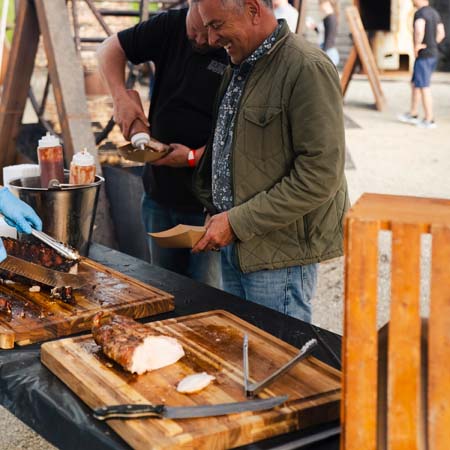
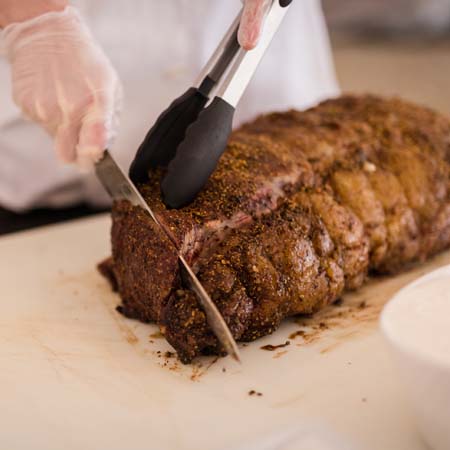
But Discovery Fire reaches back earlier than the modern American barbecue category. The type of food I am after is closer to the old origins of live-fire cooking: meat over flame, food near coals, sausages made with real intention, heat that has to be read instead of programmed, and flavor that comes from wood, fat, salt, smoke, char, timing, and the quality of the ingredient itself.
A lot of modern barbecue leans heavy: sweet sauces, sticky glaze, big sugar, big fat, big immediate impact. People love it for a reason, but I am not very interested in chasing the quick or easy dopamine or serotonin hit from excessive fats and sugar. I do not want food that hijacks your taste buds for ten minutes and then leaves you feeling you ate a brick.
I want food that lands deeper than that. High-quality meats. Homemade sausages built for real flavor. Smoke, flame and embers that supports the food instead of covering it. Fire that brings out something primal without burying everything under sauce and a rush of sweet fat. Less of a blast, more of a pull. The kind of food that makes sense outdoors, on a farm, with fire in front of you and open space around you.
Why People Slow Down Here – A Way of Being Present
One of the things I pay attention to is how people change after they have been here for a little while. At first, most people look for the rules. Where do I go? What do I do first? Am I missing something? Is there a line? Is there a schedule? Then they realize the evening is not going to fall apart if they stop trying to manage it. They can follow their instincts a little, and somehow that becomes the right way to experience it.
The food is there. The fire is there. The music is there and so are the pasture yard games and activities. The farm is open. They can wander, eat, pause, come back, sit down, stand near fire, rejoin their group, go find something else. There is enough structure to feel taken care of and enough freedom for the evening to become theirs. That is where the “being present” part happens. Not in a forced or serious way. More like people slowly stop planning the next move and start noticing the one they are already in.
There is something about a large, natural, historic property that helps with that. Acres of room to move changes people. The old expansive property offers a kind of comfort before we even add anything to it. Then fire, wood-fired food, music, activities, community, and a summer night opening up instead of closing down start working together. You feel the air, the ground, the smoke, the food coming off the fire, the kids moving around, the conversations drifting and coming back. It pulls people into the moment without asking them to make a big thing of it.
It is relaxing, but not passive. There is plenty to do and nothing that must be done at the same time — which is probably what makes it feel different. No feeling that you have to keep up. A lot of leisure has become strangely busy, even when we are trying to relax. We are still half-scheduling ourselves through it. I wanted Discovery Fire to push gently against that busy way of being using this beautiful old farm, real fire, great food, open air, and enough space to stop trying so hard. Maybe that is the simplest way to say it: people slow down here because the place gives them permission to actually be where they are.
Why It Belongs in Coeur d’Alene
I do not think Discovery Fire would feel the same just anywhere. Coeur d’Alene Idaho already has the right ingredients for this kind of experience: long summer evenings, open air, water nearby, mountains around us, grass, dust, pine, wood smoke, changing light, and people who understand that being outside is part of living well.
The lake gives one kind of evening. A trail gives another. A good restaurant gives another. Discovery Fire brings together firelight, food cooked in front of you, music moving through open space, and a historic farm that has found a new way to work.
That is why I think it belongs in the conversation about the best things to do in Coeur d’Alene. Maybe even the things you should not miss. Not because we get to say that and make it true, but because people might feel it after being here: the fire, the food, the room to explore, the comfort of the old farm, the smell of wood smoke when they get home, and a few hours where life did not feel so rushed.
So yes, Discovery Fire is one of the things to do in Coeur d’Alene. That phrase is true. It just does not quite cover it. Some things are worth seeing. Some are worth tasting. Some are worth doing. Every once in a while, there is something worth entering and experiencing in a subtle deeper way. That is what we are trying to build here.